From enterprise signals to governed action.
Six layers, each one taking a specific input and producing a specific output. Open any layer for the plain-language version.
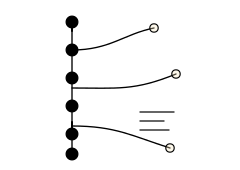
- 1
Enterprise Inputs
Code, documents, tickets, communications, business systems, operational data, incidents, telemetry, organizational records, and human decisions.
- 2
Canonical Enterprise Knowledge Graph
A living, text-attributed, temporal graph that resolves the same real-world entities across disconnected systems and maps their relationships, ownership, history, and dependencies.
In plain terms
One shared map of the business. The same service, supplier, or product appears once — not five times under five names — and the map remembers how it changed.
- Takes in
- Raw enterprise signal
- Hands on
- Resolved entities and relationships over time
- 3
F3M — Predictive Graph Model
A graph-native predictive engine designed to learn how relationships, changes, and events propagate through the enterprise.
- 4
GRI — Graph Reasoning Interface
A compact, typed bridge that packages relevant graph structure, temporal context, predictions, provenance, and permissions for the reasoning layer.
- 5
F2RM — Graph-Aware Reasoning Model
A reasoning model designed to turn structured enterprise intelligence into explanations, plans, documents, decisions, and tool actions.
- 6
Agent OS and F2 Cockpit
The orchestration and control layer that manages multi-step workflows, approvals, tool access, provenance, audit trails, and human oversight.
The platform does more than retrieve. It builds an operational understanding.
Entity resolution
The same service, asset, product, person, supplier, decision, or event may appear under different names across multiple systems. Blue River resolves those fragments into one canonical entity.
Structural and temporal context
The graph captures not only what is connected, but how ownership, dependencies, states, and events change over time.
Predictive graph intelligence
F3M is designed to model propagation, risk, likely ownership, likely outcomes, and other signals that cannot be obtained through semantic similarity alone.
Grounded reasoning
GRI provides the reasoning model with a structured briefing rather than an undifferentiated wall of retrieved text.
Governed execution
F2 Cockpit gives people visibility into what the system knows, why it recommends an action, what it plans to do, and where approval is required.
Agent-Agnostic by Design
An ecosystem, not another closed copilot.
The intelligence layer is designed to support workflows built by the enterprise, individual teams, employees, Blue River Labs, and approved third-party providers. Every workflow should inherit the same grounded context, permissions, provenance, and governance.
Platform Direction
Described as designed intent and architectural direction, not generally available marketplaces.
Designed to Enable
Enterprise Workflow Exchange
A team or employee can define a useful workflow for day-to-day work, test it within enterprise controls, and make it available through an internal catalog. Enterprise-wide workflows can be centrally governed while individual workflows remain scoped to the user's permissions.
Designed to Enable
Partner Agent Ecosystem
Vetted third-party applications and agents can connect through governed interfaces and operate inside customer-controlled privacy and permission boundaries. The intelligence layer remains neutral: the best agent for a task can use the same trusted enterprise foundation.
Autonomy earns trust through visibility and control.
Provenance
Every material recommendation should show the nodes, relationships, events, documents, and signals that informed it.
Human control
Sensitive actions can be approved, rejected, modified, escalated, or constrained before execution.
Policy-aware execution
Workflows must respect existing role-based access, data boundaries, and organizational controls.
- Step 1
Recommendation
Proposed action with predicted impact.
- Step 2
Evidence path
Nodes, events, and documents that informed it.
- Step 3
Approval state
Awaiting human review under policy.
- Step 4
Audit record
What was known, decided, and by whom.
Bring intelligence to the data—not sensitive data to an uncontrolled model.
- Customer-controlled deployment patterns, including private-cloud or VPC-oriented architecture where appropriate.
- Role-based access and permission-aware retrieval.
- Traceability, approvals, and audit trails.
- Modular industry adaptation without rebuilding the intelligence foundation from zero.